Monthly Archives: April 2025

CHAPTER ONE

Introduction

In other words, natives, who are our kind of people at a different level of knowledge, feel the way we do; and feel about us rather as we would be likely to feel about men with superior equipment coming from Mars. The impact our civilization makes on them is a disturbing, fascinating, frightening impact on people so like ourselves that the differences don’t matter. As J. K. Murray … said, “We cannot continue to use the word native as if it meant something less than the word man.” (Simpson 1962, 378)


Colonialism in Papua was always, and necessarily, represented and viewed through a sequence of usually unrecognised filters as it described and recorded its own world, its modes of operation, and the worlds in which its subject others lived and the modes of operations within them. Of course the traditional —the other— view of these same worlds had its own framings and filters, but this view was rarely sought by modernity’s agents and thus rarely recorded, except at times when this was done, incompletely, and in translation by anthropology.


Ambiguities and modern colonial upbringing


Childhood experiences gave me a sentimental sympathy for a statement made by Dame Rachel, wife of a long serving administrator Sir Donald Cleland, wherein she expresses shock at the idea that Australian activity in Papua New Guinea was colonialism “…that was not in any way the thinking” (Nelson 1982). Now however, I recognise that the following cold statement of Downs’ is more realistic:

Australia began as a metropolitan power in Papua and New Guinea and in all respects this was a colonial situation. There is no derogatory meaning in this description. (Downs 1980, Introduction)

In 1973 Michael Somare sent me to the Sepik to undertake a specific and purposeful tour of the river’s magnificent traditional Melanesian architecture. Newly appointed as architect for the National Museum project this was to be a voyage of discovery, a modern sort of initiation, to validate my eligibility to continue. Plans for this symbolic building —one that would house old and sacred Melanesian treasures— would be revised after this introduction to living Melanesian architecture and culture. The experience was eye- opening, it revealed depths in a world hardly imaginable from glimpses of it in books.
Twenty years later a book was published of Frank Hurley’s dramatic photographs of 1920 and 1923 with Papuan people, scenery and detailed pictures of architecture. (Specht 1984). The stunning images rekindled memories of traditional architecture that I had seen in the Sepik, the Trobriands and the Gogodala in the 1970s. The architecture in Hurleys photographs gave direction to this study.
However my experiences of tradition and modernity started much earlier. As a white kid growing up in the Highlands of New Guinea in the 1950s I lived a modern existence, but there was also a deep sense of joy and wonder at the richness of the so- called primitive and pristine world at hand.
Outdoors there were jet trails at 30,000 feet in the intense blue sky on clear sunny days whilst I took young Tari buddies4 for swimming lessons in the cold mountain streams. They told me of the natural world of the rainforest and of the spiritual significance of the flora and fauna. It was all amazing and fascinating. My nonchalance about the technological modern world intrigued them. We were children comparing strangely different worlds equally, and without prejudice.
Indoors there was Radio Australia and the popular children’s program “The Argonauts”. On our shelves were issues of Life magazine with Bell—X experimental jet planes breaking the sound barrier. This fantastic experience of modernity went on in the lounge room of our house,5 whilst primitive drumming sequences sounded distantly on the night air outside. Everyday life in Goroka then was composed from these juxtapositions.
It was a new type of colonial life in a small cocoon of ‘civilisation’, in a large exotically- peopled, mountain-surrounded, cloud-shrouded, high valley. Fog rolled like a steam train trail as it ran around the edge of the valley floor in the still of the pre-dawn, and shouted tribal calls and echoes reverberated around the valley with it. At dawn, over on the police compound, bugles sounded and the flag was formally raised, in a ritual of a fading British Empire consolidating its exotic outpost. There would be a pause, a waiting time for the fog to be burnt off by the sun, and then the people would emerge from their thatched-in, smoky houses, and the aeroplanes would start taking off and landing.
Goroka was reputedly the busiest airport in the Southern Hemisphere for a time during the mid nineteen-fifties. Coffee and vegetables went out and materials to expand the town’s infrastructure, and equipment for the development of the valley came in.
Building activity matched the weird plurality of other aspects of life. Prefabricated timber bungalows known as ‘Bulolo’ houses, were flown into Goroka in pieces and assembled because access to the valley was by aircraft (or by foot with difficulty through rough terrain and past unruly tribes). In 1952 all other buildings were made of bush materials. There were complex and contradictory interactions. Conical thatch-roofed round village houses huddled together in the traditional stockade within the lush gardens of the people. In town a vast metal-framed hangar sheltered maintenance work on a fleet of small aircraft. Ad-hoc colonial facilities made of bush material buildings sat next to flash prefabricated ones recently flown in. The town grew. Buildings of permanent materials came to predominate as aeroplanes became bigger, and the airstrip became longer, and as larger loads could be brought in.
At the start of the 1960s the Highlands Highway was connected to the coast down the precipitous Kassam pass and across a new large steel bridge spanning the erratic and powerful Leron River. The magic of isolation and sense of exoticism was broken by this pragmatic road connection to the bustling international port at Lae.
As a child, views of the outside world were strongly coloured by revelations from local companions with whom I talked. Their impressions of other tribal people outside the valley carried the weight of authenticity. We knew that there were cannibals at the far end of the valley. The area behind the majestic Mount Michael was their fearsome home. Later many of these people would be brought into the hospital at Goroka suffering and dying from the laughing sickness called kuru. The identification of kuru and its mode of transmission placed Goroka at the centre of an international medical sensation.
The main river, the Asaro, mysteriously exited the valley in the direction of Mount Michael, apparently snaking its way through a wall of mountains, but, it was known to somehow flow into the even bigger Waghi river of the neighbouring valley. We understood that these two rivers joined to descend in a great waterfall, to collect more rivers from further afield, and to become the mighty Purari River that emptied through a vast network of jungle-covered swamps into the Gulf of Papua.
The intrigue of the coexistent modern and traditional worlds deepened later as I encountered the workings of development, cooperative societies, and extension concepts. These, then current, Western ideas of progress and enlightenment were about managing change in third world communities who were being groomed to join the modern world. Excitement, “revolution at last”, and hope was palpable on the eve of independence for a number of us young 1960s trained professionals in the early 1970s.
I was comfortable with my credentials of being born and of growing up in New Guinea. Belief, idealism and rhetoric about self-government and self-sufficiency fuelled enthusiastic efforts to achieve the new agendas of the new nation through architecture. Awakening to some of the hidden glories in traditional Melanesian culture added richness to the opportunities. Combining cultural awareness, principles for energy efficient building, and the use of local resources it seemed possible to find a new architecture for this new country.
Eventually things became muddied and messy in the mire of unfolding pragmatic politics and entangled webs of influence, patronage and opportunism. Letters to newspapers and copies of documents from colleagues show a group of young idealists struggling to provoke debate on architectural and planning issues based on the proclaimed national aims.
The accident of having been born in New Guinea turned out to be largely irrelevant in terms of citizenship or nationality in the new nation state. My Australian mother provided a heritage that instantly gave me an Australian passport. On reflection there is now some sense of loss for the excitement and conviction at the start of nationhood, and the then palpable cultural awakening that accompanied it. A personal need to understand and explain some of these complex things is inevitably bound up with various aspects of this story.
The counterpoint that keeps getting sharper for me today is in the parallels to be drawn between the modern colonial process in Papua New Guinea and the continuing globalising processes generally in the Third World at large. Modernity continues to exert its influences even as it continues to change and metamorphose itself. A developing worldwide hegemony, and the spread of homogeneity contrasts with the possibilities for richness that could come from the tolerance of difference.
It should now, more than ever, be possible to sustain differences in our contemporary global village. But there are still unresolved dilemmas as globalism brings into focus for me the same sorts of issues raised by the colonial process in Papua, and appears to repeat the effects this process had on the Melanesian peoples, their cultures, and their architectures. The story of the architecture in this study shows that by 1975, at the time of Papua New Guinea’s independence, some primary issues about the contemporary role of cities, of towns, of villages, and of architecture were unresolved in the psyche of the nation.
Papuan Transformations

This is a story about people, art and architecture. and social and cultural interactions. It involves the Motu, Purari and Orokolo peoples interacting with westerners in what was British New Guinea from 1884 but became the Australian Territory of Papua from 1901. It became Papua New Guinea in 1975.

INTRODUCTION

In other words, natives, who are our kind of people at a different level of knowledge, feel the way we do; and feel about us rather as we would be likely to feel about men with superior equipment coming from Mars. The impact our civilization makes on them is a disturbing, fascinating, frightening impact on people so like ourselves that the differences don’t matter. As J. K. Murray … said, “We cannot continue to use the word native as if it meant something less than the word man.” (Simpson 1962, 378)
Colonialism in Papua was always, and necessarily, represented and viewed through a sequence of usually unrecognised filters as it described and recorded its own world, its modes of operation, and the worlds in which its subject others lived and the modes of operations within them. Of course the traditional —the other— view of these same worlds had its own framings and filters, but this view was rarely sought by modernity’s agents and thus rarely recorded, except at times when this was done, incompletely, and in translation by anthropology.
Ambiguities and modern colonial upbringing
Childhood experiences gave me a sentimental sympathy for a statement made by Dame Rachel, wife of a long serving administrator Sir Donald Cleland, wherein she expresses shock at the idea that Australian activity in Papua New Guinea was colonialism “…that was not in any way the thinking” (Nelson 1982). Now however, I recognise that the following cold statement of Downs’ is more realistic:
Australia began as a metropolitan power in Papua and New Guinea and in all respects this was a colonial situation. There is no derogatory meaning in this description. (Downs 1980, Introduction)
In 1973 Michael Somare sent me to the Sepik to undertake a specific and purposeful tour of the river’s magnificent traditional Melanesian architecture. Newly appointed as architect for the National Museum project this was to be a voyage of discovery, a modern sort of initiation, to validate my eligibility to continue. Plans for this symbolic building —one that would house old and sacred Melanesian treasures— would be revised after this introduction to living Melanesian architecture and culture. The experience was eye- opening, it revealed depths in a world hardly imaginable from glimpses of it in books.
Twenty years later a book was published of Frank Hurley’s dramatic photographs of 1920 and 1923 with Papuan people, scenery and detailed pictures of architecture. (Specht 1984). The stunning images rekindled memories of traditional architecture that I had seen in the Sepik, the Trobriands and the Gogodala in the 1970s. The architecture in Hurleys photographs gave direction to this study.
However my experiences of tradition and modernity started much earlier. As a white kid growing up in the Highlands of New Guinea in the 1950s I lived a modern existence, but there was also a deep sense of joy and wonder at the richness of the so- called primitive and pristine world at hand.

Endnote to Intro

COASTAL MELANESIA was exposed early to brief Western exploration in a limited number of places and the recording of the peoples architecture was not a priority. Survival, obtaining supplies of fresh food and water were. For Melanesians in those very early days such visitors appeared to be extremely strange and possibly dangerous.
These weird creatures arrived in equally strange vessels. The intruders neither knew that the local language may be different to their own, nor did they conceive of any possible local visiting protocols. The records these early voyages produced were written. Some objects may have been collected to take home. All else had to be sketched.
Largely due to the enlightenment and scientific explorers such as James Cook of the late eighteenth century produced quite exhaustive detailed sketching. This then became an expected outcome of voyages. More frequented islands and coastal villages would become familiar with frequent presence of western visitors. Sometimes stories about such visitors would be passed along local trading routes, softening the shock of first contact with people so different to themselves.
By the 1870s more westerners, and other people they brought with them, gradually started to find places to establish their presence. These newcomers included adventurers, traders, missionaries and planters. By the late nineteenth century some early large and clumsy cameras were brought to Melanesia by either individuals with means such as traders, or by funded collecting expeditions.
So, around this time the future nations of Melanesia were being mapped out by the foremost European nations that had colonial empires. New Guinea was divided, to Dutch NG (to the west), British NG (becomes Australian Papua) German NG (the north east, Bismarck and Admiralty Archipelagos, North Solomons – aka Bougainville), British Solomon Islands, New Hebrides (Britain and France — a condominium), French New Caledonia. British Fiji – but was then often seen as more closely related to Tonga than Melanesia.
By 1900 a cultural revolution in the arts and in architecture was well underway in some of the most important city centres in Europe: such as Amsterdam, Berlin, Hamburg, Paris, Vienna. Britain was much slower to adapt to such modern cultural change.
The European cultural excitement was to have significant influences in Melanesia in terms of the recognition and appreciation (or lack thereof) of Melanesian cultural expressions in art and architecture especially. This is revealed in the series of important recording and collecting expeditions of the period from 1900 and most particularly around 1912 and in particular the German Sepik expedition which reached the headwaters of that mighty river. And its impact from recognising and rewarding the artists and ‘architects’ of the new contacted Upper Sepik cultural groups was ground breaking in terms of anthropological awareness and cultural continuity being possible alongside modernity’s uptake by the Melanesian people of the wide and long river valley and the plains and hills it contains.
The year 1914 at the outbreak of WW2 saw the Germans leave New Guinea and their extensive Pacific Empire. Australia replaced them on their former New Guinea and islands territory. Nevertheless this part of Melanesia was on a firm new trajectory based on settings left by that short last German administration.
Dutch New Guinea remained a bit of an enigma really until sometime in the early C20th when many of the other Melanesian expeditions visited the northern coast of New Guinea before branching out into other parts of Melanesia to the north, further east and then south or southeast. Such expeditions and the presence of anthropologist doing fieldwork and curators from European museums became more common during the 1920s and 1930s. Examples
British New Guinea on the other hand had a very lacklustre beginning, improvement and expanded exploration under Administrator McGregor before becoming Australian controlled from 1901. It was not until Murray took over the Australian Administration in 1907 that a new era began in Papua (his new adopted name for the territory).
From 1914 and during WW1 Murray was asked to conceal ‘well out of the way’ the presence of young Polish aristocrat anthropologist Malinowski who otherwise would have been interned in Australia as an enemy alien. The result of this sojourn in the Trobriand Islands was obvious friendship with his fieldwork subjects and their trading ring partners the famous book Argonauts of the Southwest Pacific and the other books in the series. Malinowski also became famous for his photography from this fieldwork.
While conservative in his views, the ideals of a Protectorate were a key to Murray’s ambitions for the Papuan people. By 1920 he employed Government Anthropologist F.E.Williams, claiming this as an enlightened ‘first’ such appointment in the British Empire. In spite of this he, often while championing and publishing the FEW’s reports and books, he claimed ‘practical realities’ to excusing ignoring FEW’s advice, especially regarding education for ‘natives’. He relied on Christian mission schools although having to hound some of them into complying with the requirements of the civil curriculum.
The important cultural homelands of the Purari and Orokolo peoples were in the Papuan Gulf. They, the peoples of the Sepik River, and the Asmat peoples of the west coast of Dutch NG were identified as very significant by art curator and collector Douglas Newton in the 1960s. As he saw it, they could be grouped as a visually strong and stylistically related Melanesian artistic regions.
The Sepik River people and the Asmat peoples will appear later as sections that have very different cultural, art and architecture outcomes. These societies went through quite different sequences of westerner experiences to that of the British/Australian regimes in Papuan Transformations. The Sepik were in German NG and the Asmat in Dutch NG. Both being continental Europeans with different cultural outlooks and relationships to Melanesians, art and architecture. There were also the complications of WW1 and WW2 and changing colonial periods.
Papuan Transformations will appear in sequential book-like sections. It is a detailed journey through a numbers of aspects of the Melanesian Art-Architecture Project.
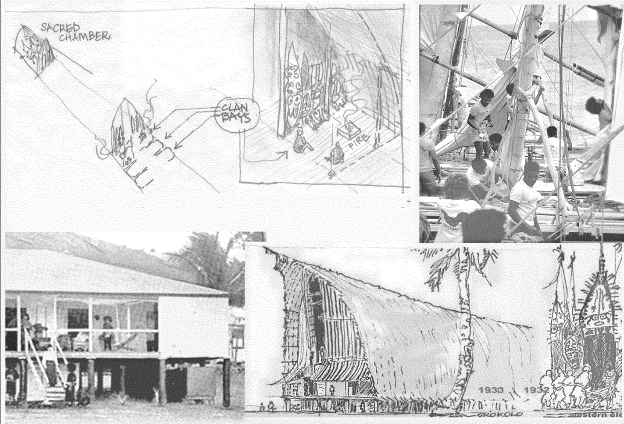
This the story of how the two different Gulf peoples deserted their large villages, their houses and ceremonial architecture. By 1975 they were living in shacks built from salvaged materials as squatter settlers on Motuan donated hillside land around Port Moresby in the 1960s.
The Purari and Orokolo were people who had traditional trading ties with the seafaring Motu people from the coastal areas around Port Moresby. The societies has cultural changes with starkly different outcomes over the periods between first contact and independence in 1975. The details and evidence came from colonial records and through the evidence captured by photographers and others and form Papuan sources recorded in books, art shows and so on from around the 1960s onwards.
Papuan Transformations deals with the territorial settings and the contexts which inform the understanding and the interactions of the various cast actors. As well it outlines the narrator’s journey into his appreciation of Melanesian peoples building skills, art and architectural expressions. On the other hand there are the overt, or the implied influences of the western presence on these aspects of local culture as it became dominant in the Papuan village societies and towns through the various periods up to 1975.